

Sleep Might Matter More Than Dose for Your GLP-1
You’ve always eaten late. Not because you planned to, not because a doctor told you it was fine, but because that’s when the house finally slowed down. The kids were fed, the kitchen was wiped, the phone stopped buzzing, and somewhere around 10:30 you sat down with leftovers or a bowl of cereal or whatever was easy. You weren’t bingeing. You were decompressing. And nobody in your family called it a problem because everybody did it.
Now there’s a class of medications that, among other things, makes that late plate disappear — and the relationship between GLP-1 late night eating suppression and your body’s own rhythms is more tangled than most prescribers let on. GLP-1 receptor agonists like semaglutide and tirzepatide have entered millions of households and rearranged how hunger feels. The late-night craving that used to pull you toward the kitchen? On these drugs, it often goes quiet. That sounds like pure progress. But the silence has a shape, and in Latino families, that shape touches things a prescription label doesn’t cover: who you eat with, what refusing food means, and whether “eating less” reads as health or as something gone wrong.
This is the part of the GLP-1 era that hasn’t been studied well enough. The pharmacology is moving fast. The cultural questions are barely keeping up.
How GLP-1 Medications Actually Suppress Late-Night Hunger

Let’s start with the mechanism, because it matters for understanding what happens after dark.
GLP-1, or glucagon-like peptide-1, is a hormone your gut produces when you eat. It does several things at once: it signals your pancreas to release insulin, it slows gastric emptying so food sits in your stomach longer, and it communicates with your brain’s appetite-regulation centers in the hypothalamus and brainstem. The net effect is that you feel full sooner and stay full longer. Drugs like semaglutide (Ozempic, Wegovy) and tirzepatide (Mounjaro, Zepbound) mimic this hormone at supraphysiological levels, meaning they activate GLP-1 receptors far more intensely than your body’s own peptide does.
A 2023 review in *Diabetes, Obesity and Metabolism* noted that GLP-1 receptor agonists can specifically blunt late-day hunger and reduce nocturnal eating. This isn’t just a side effect. It may actually reinforce more circadian-aligned eating patterns, shifting food intake toward earlier hours when your metabolism is better equipped to handle it. Your body processes glucose more efficiently in the morning than at night. Insulin sensitivity follows a diurnal rhythm, peaking in the first half of the day and declining as evening approaches. So when a GLP-1 drug dampens your desire to eat at 11 PM, it’s accidentally aligning your behavior with your biology.
But here’s where it gets more complicated. The same circadian system that shapes your appetite also determines how well these medications work.
Sleep Quality May Affect How Well Your GLP-1 Drug Works
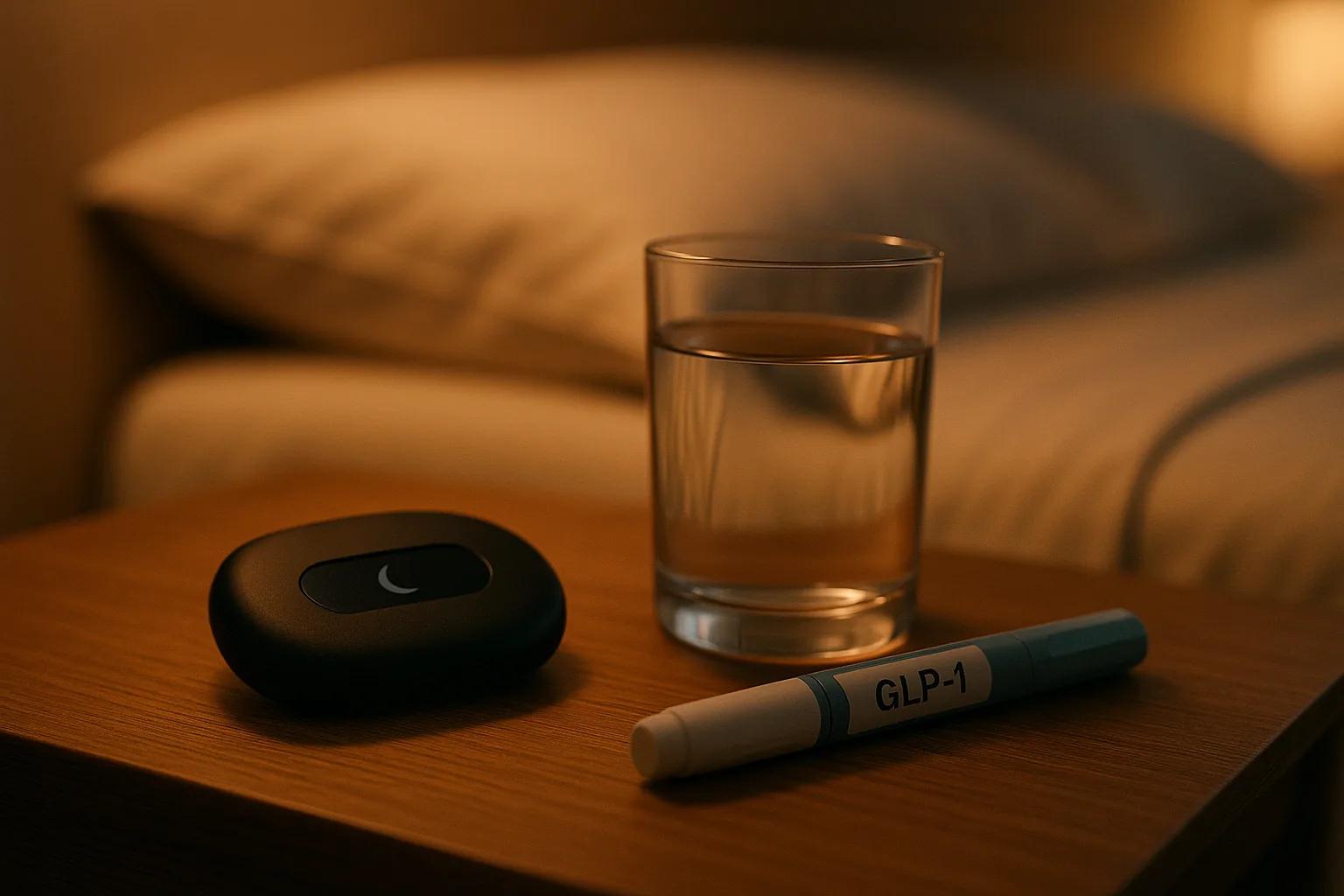
This is the connection most prescribers aren’t emphasizing enough. A 2024 observational study published in *Obesity Science & Practice* found that better sleeping habits were associated with greater weight-loss efficacy during oral GLP-1 receptor agonist treatment. The association was especially pronounced among women. People who slept more consistently and reported higher sleep quality lost more weight on the same medication than those who didn’t.
Why would that be? Because sleep is not a passive state when it comes to appetite hormones. It’s the period when your body recalibrates the entire system.
Short sleep and fragmented sleep are both associated with measurable hormonal shifts that work against everything a GLP-1 drug is trying to do. A 2023 sleep-fragmentation study in the *Journal of Clinical Endocrinology & Metabolism* found that after a night of disrupted sleep, participants reported higher desire-to-eat ratings after dinner and had lower circulating GLP-1 and lower subjective fullness the following day. In other words, bad sleep doesn’t just make you tired. It lowers the very hormone these drugs are designed to mimic.
The broader research confirms the pattern. Sleep deprivation increases ghrelin, the hormone that signals hunger, and decreases leptin, the hormone that signals satiety. It also shifts food preferences toward high-carbohydrate, calorie-dense options — a finding documented across multiple studies, including a widely cited 2004 analysis in *Annals of Internal Medicine* by Spiegel et al. This isn’t a willpower failure. It’s a hormonal environment that actively promotes overconsumption. When you layer GLP-1 medication on top of chronic poor sleep, you’re essentially fighting the drug’s mechanism with your body’s own counter-signals.
For anyone working late shifts, caring for children through the night, or dealing with the kind of stress that fragments sleep into shallow, restless stretches, this matters enormously. The drug might reduce your appetite during the day. But if your sleep is wrecked, your body may still be pushing you toward food at the exact hours the medication is supposed to protect you from.
Why Energy Crashes on GLP-1 Meds Aren’t Just About Eating Less

One of the most common complaints among people on semaglutide or tirzepatide is fatigue. Not the kind of tired you feel after a long day, but a heavy, mid-afternoon crash that feels metabolic. Many people assume this is because they’re eating fewer calories. That’s part of it. But the hormonal picture is more layered than a simple calorie deficit.
When you dramatically reduce food intake, especially if the reduction is concentrated in certain macronutrients, your body adjusts its energy allocation. Leptin levels drop, which signals to your brain that energy stores are declining. Cortisol can rise in response to the perceived stress of reduced intake. And if your sleep is already compromised, the ghrelin-leptin imbalance gets worse, creating a feedback loop: you eat less, you sleep poorly because your hormones are disrupted, and you feel exhausted because your sleep was poor and your caloric intake can’t compensate.
There’s also the gastric emptying issue. GLP-1 drugs slow the rate at which food leaves your stomach. This is central to how they create satiety. But it also means that the glucose from your meals enters your bloodstream more gradually and in smaller surges. For most people, this is metabolically beneficial. But if someone is used to relying on quick-digesting carbohydrates for energy, especially later in the day, the transition can feel like running on empty. The body isn’t crashing because it’s broken. It’s adjusting to a fundamentally different fuel-delivery timeline.
What’s missing from most clinical conversations is any discussion of how to restructure meals and sleep simultaneously when starting these medications. The drug changes your hunger signals. But nobody reprograms the circadian habits that built those hunger signals in the first place.
Circadian Eating Alignment: What Meal Timing Has to Do With GLP-1

Circadian researchers have been making a case for years that when you eat may matter as much as what or how much you eat. The evidence is substantial. Irregular meal timing, abnormal light exposure, and misaligned sleep-wake cycles can impair metabolic control in ways that overlap significantly with the pathways GLP-1 drugs target.
Your pancreatic beta cells, the ones that produce insulin, follow a circadian rhythm. They’re more responsive in the morning. Your gut’s own GLP-1 secretion follows a similar pattern. Eating a large meal at 9 PM asks your body to do its metabolic work during its off-hours, and the result is often higher postprandial glucose, less efficient fat oxidation, and greater fat storage. This is true regardless of whether you’re on medication.
When a GLP-1 drug suppresses your late-night appetite, it’s pushing you toward a pattern that circadian science already supports: eating during daylight hours and tapering intake as evening comes. The alignment is elegant. But the execution, in real life, runs into a wall that clinical trials rarely account for.
What “Eating Less” Means in a Latino Household
In many Latino families, dinner isn’t just a meal. It’s the axis around which the household turns. It’s the hour when everyone is finally in the same room. It’s the grandmother who shows love by filling your plate. It’s the partner who interprets a full serving as respect and a half-eaten one as a message. The phrase “ya comiste?” isn’t a nutritional inquiry. It’s an expression of care.
This is not an exotic cultural detail. It’s an architectural feature of how millions of families organize daily life. And GLP-1 medications walk directly into this architecture without any awareness of it.
When someone on semaglutide says they’re not hungry at dinner, the pharmacological explanation is straightforward: the drug has activated satiety circuits in the hypothalamus and slowed gastric motility so the person genuinely doesn’t want more food. But the family sitting around the table doesn’t hear pharmacology. They hear rejection, or worry, or something that looks like illness. In families that have experienced food insecurity, where a full plate was never guaranteed, someone voluntarily leaving food can feel like a moral transgression. You don’t waste what was hard to get.
There’s also a generational layer. For younger family members, “eating less” might align with modern medical goals and feel like a responsible health decision. For older family members, especially those who lived through periods when food was scarce, eating less can signal deprivation, not discipline. The same behavior gets read through entirely different frames depending on who’s watching.
And this tension doesn’t resolve on its own. It lives in the kitchen, at the weekend cookout, at the Sunday table where three generations share a meal. A person on GLP-1 medication navigating this dynamic is managing more than pharmacology. They’re managing a family’s history with food — what abundance meant after scarcity, what a full plate said about stability, what it means now when someone pushes it away. The drug has no opinion about any of this. But the family does.
None of this shows up in the clinical trial data for semaglutide or tirzepatide, because drug trials measure endpoints like HbA1c, body weight, and adverse events. They don’t measure what happens at the table when your tía notices you didn’t finish your arroz con pollo. But for the person on the medication, that dinner table moment might be the hardest part of the entire treatment. Harder than the nausea. Harder than the injection.
The Late-Night Meal Was Never Just About Hunger
Here’s what gets lost in the medical framing: the 10:30 PM plate of food was doing more than one job. Yes, it addressed hunger. But it also marked the transition from work mode to rest. It was a sensory reward at the end of a long day. For people working second shifts or splitting caregiving duties, it was sometimes the only meal eaten without rushing or standing up or feeding someone else first.
GLP-1 medications don’t replace those functions. They just remove the appetite that justified the ritual. What’s left is a gap. And people fill gaps with different things. Some find the freedom from late-night eating liberating. Others describe a low-grade sense of loss they can’t quite name. The food wasn’t the point. The moment was the point. The food was just the excuse to take it.
This is particularly relevant in communities where work schedules don’t align with the circadian ideals that researchers describe. Telling someone who gets home at 9 PM that they should eat their main meal before 2 PM isn’t practical advice. It’s an abstraction. The challenge isn’t whether circadian-aligned eating is metabolically superior. The evidence says it is. The challenge is building a bridge between that evidence and the actual lives people lead.
A Second Mechanism Worth Knowing: GLP-1 and the Reward System
Beyond hunger and satiety, GLP-1 receptor agonists appear to modulate the brain’s reward circuitry. Research published in *Nature Medicine* (Rubio et al., 2023) has shown that semaglutide reduces activity in areas of the brain associated with food reward and craving, including parts of the mesolimbic dopamine pathway. This is the same system involved in alcohol cravings and certain compulsive behaviors, which is why there’s growing interest in whether GLP-1 drugs might have applications beyond metabolic disease.
For late-night eating specifically, this matters because much of what drives nocturnal snacking isn’t caloric need. It’s reward-seeking. After a stressful day, the brain looks for dopamine. Sweet, salty, crunchy foods deliver it efficiently. When a GLP-1 drug dampens that reward response, the late-night pull toward the pantry weakens not because the stomach is full but because the brain isn’t asking for the hit.
This dual mechanism, appetite suppression plus reward modulation, helps explain why people on these medications often report that their relationship to food changes in ways that feel unfamiliar. They’re not just eating less. They’re wanting less. And wanting less, in a culture that expresses love and connection through food, introduces a kind of emotional recalibration that no one warned them about.
Practical Takeaways for the GLP-1 Era
So what actually helps?
First, sleep isn’t optional when you’re on a GLP-1 medication. It’s arguably a co-treatment. If you’re sleeping five or six fragmented hours, you’re undermining the drug’s efficacy through the same hormonal channels it’s trying to correct. Ghrelin stays high. Leptin stays low. Your body’s own GLP-1 production drops. Prioritizing consistent sleep, even imperfect sleep, isn’t a luxury recommendation. It’s a pharmacological one.
Second, meal timing deserves as much attention as meal content. If the medication has reduced your appetite in the evening, lean into that. Front-load your calories. Eat a substantial breakfast and lunch. This aligns with your circadian insulin sensitivity and may reduce the energy crashes that plague the afternoon. You don’t need to eliminate dinner. But letting dinner become lighter, if that’s where your appetite naturally goes on the medication, is working with your biology rather than against it.
Third, and this is the one that doesn’t fit on a prescription label, talk to your family. Not about the drug’s mechanism. About what’s changing. If dinner was the connective tissue of your household, acknowledge that the tissue is being remodeled. Maybe you sit at the table without a full plate. Maybe the ritual shifts from eating together to being together. Maybe you explain to your grandmother that the half-eaten plate isn’t disrespect — it’s a different kind of taking care of yourself. These conversations aren’t easy. But the alternative, silently rearranging a family’s food culture without explanation, tends to produce confusion and hurt.
One recommendation from the evidence: if you’re starting or currently on a GLP-1 receptor agonist, ask your prescriber about your sleep. Not as an afterthought. As a primary variable. If your sleep is consistently poor, addressing it may improve your treatment response more than adjusting the dose. The observational data on sleep quality and GLP-1 efficacy is still emerging, but the direction is clear enough to act on. Better sleep supports the hormonal environment these drugs need to work in. Without it, you’re medicating against a current.
The GLP-1 era is real. The medications work. But they work inside a body that sleeps, inside a home that eats together, inside a culture that reads “eating less” through a lens no clinical trial has bothered to look through. The pharmacology is only half the story. The other half is yours.